
What Shopify's 2026 Retention Data Tells Us About When to Deploy a Quiz in the Customer Lifecycle

Most Shopify stores lose roughly seven out of every ten first-time buyers before they ever come back. That's not a guess – Shopify's own 2026 customer retention guide puts the average repeat customer rate at 28.2%, which means the inverse, a near-72% drop-off, is simply the baseline most merchants are working against. The real question isn't whether retention is a problem. It's where, exactly, a store should be spending effort to fix it.
Email automation data from 2026 gives a surprisingly clear answer. Flow-based emails – the ones triggered by something a customer actually did – generate a disproportionate share of revenue compared to broadcast campaigns sent to everyone at once. That gap says something bigger than "automation is good." It says timing and personalization, applied at the right moment, outperform volume every time. A quiz, placed correctly, is one of the few tools that can feed that timing engine with real, customer-declared data instead of guesswork.
Why Shopify Customer Retention Has Become the Real Growth Lever
Acquisition costs keep climbing. Retention costs don't, at least not at the same pace.
According to a 2026 Shopify customer retention statistics roundup, the average ecommerce customer acquisition cost sits between $45 and $65, while retention-focused activities cost roughly $7 to $12 per retained customer. That's a five-to-seven-times difference in cost, and it's part of why so many merchants are shifting budget away from paid ads and toward keeping the customers they already have.
A few numbers make the case even harder to ignore:
Repeat customers spend 67% more per order on average than first-time buyers, according to Bain and Co data.
Increasing retention by just 5% can raise profits by 25% to 95%, a figure that traces back to Bain & Company research and gets repeated across nearly every retention study published this year.
Only about 18% of Shopify stores allocate more than 30% of their marketing budget to retention, leaving most of the opportunity on the table.
What Counts as a Healthy Shopify Customer Retention Rate
According to comprehensive industry studies by Shopify, Klaviyo, and various e-commerce benchmark providers, customer retention rates fluctuate significantly based on purchase frequency and product lifespan:
Category | Average / Typical Retention Rate | Notes & Buying Behavior |
Subscription / Consumables | ~50% – 72% | Highest retention due to automatic recurring billing and rapid replenishment cycles (e.g., vitamins, coffee, pet food). |
Beauty and Skincare | ~35% – 45% | High repeat intent due to products running out, though highly vulnerable to brand-switching without personalization. |
Apparel and Fashion | ~25% – 30% | Moderate retention; driven heavily by seasonal drops, trends, and loyalty incentives. |
Furniture and Electronics | ~12% – 20% | Lowest retention rate; these are durable, high-ticket items with long multi-year lifecycles between purchases. |
The Baseline: Across all Shopify verticals, the average overall repeat customer rate hovers around 28% to 30%. This aligns perfectly with the fact that most standard e-commerce stores lose roughly 70% of their first-time buyers.
The takeaway isn't "hit 30% no matter what you sell." It's knowing where your category sits, and treating any meaningful gap above that baseline as a genuine performance signal.
Why Flows Beat Broadcasts (And What That Means for Quizzes)
Quick answer: automated flows convert customers at a rate campaigns simply can't match, because flows fire off real behavior instead of a calendar date.
Klaviyo's 2026 email benchmark report, built from over 183,000 brands, found that flow-based emails deliver roughly 13x higher placed order rates than standard campaigns. Flows also generate close to 41% of total email revenue from just 5.3% of total send volume. Put plainly: a tiny slice of emails, sent at the right moment, is doing most of the financial heavy lifting.
That same report makes a more specific recommendation worth sitting with – ask for preferences like product category or shopping intent at sign-up, then use that data to drive replenishment reminders and tailored offers. A quiz is, functionally, the cleanest way to collect exactly that kind of preference data before a single email ever goes out.
The Zero-Party Data Connection
A flow is only as good as the data triggering it. This is where most stores quietly fall short – they have automation tools, but the data feeding those tools is thin, outdated, or based on nothing more than past purchase history.
Recharge's subscription research backs this up from a different angle. According to Recharge's churn prevention data, brands using a structured cancellation-prevention flow – one that offers a product swap or frequency change instead of a flat discount – report churn reductions as high as 44%. The mechanism isn't the discount. It's having enough customer-declared information to offer the right alternative before the customer hits cancel.
Mapping Quizzes to the Lifecycle: Five Moments That Matter
A quiz doesn't belong on just the homepage. Treated as a recurring tool, it shows up at five distinct points in a customer's relationship with a store, and each one solves a different problem.
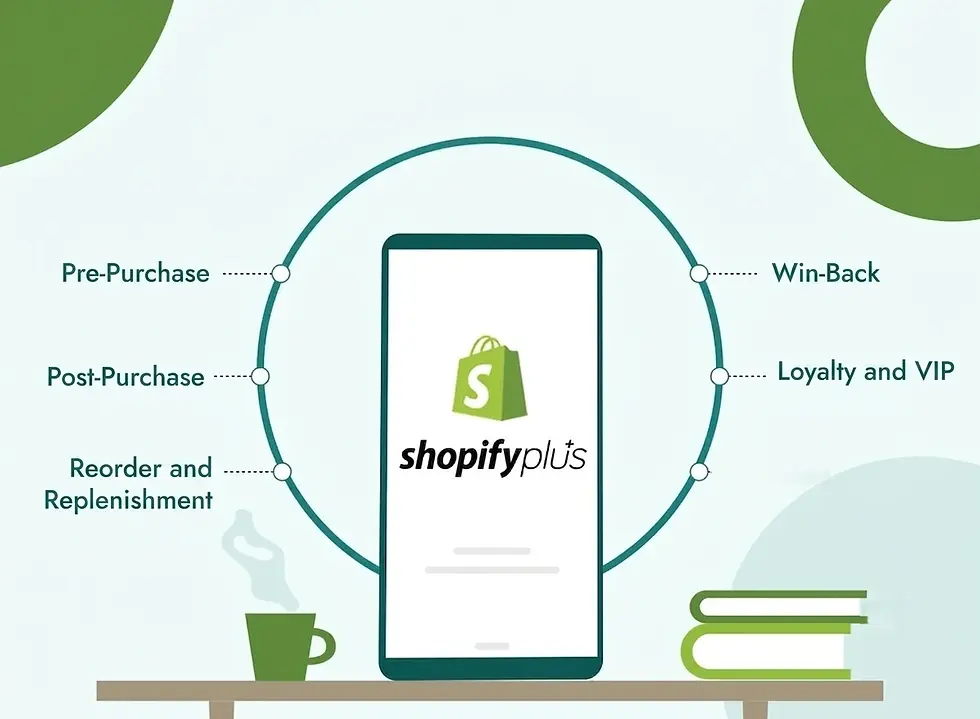
1. Pre-Purchase: Solving Choice Paralysis
Expected lift: 20–30% in conversion.
First-time visitors often freeze when faced with twenty near-identical product variants. A short product-finder quiz narrows that down to two or three relevant picks in under a minute. More importantly, every answer becomes a data point – the beginning of a personalized customer profile that exists before a transaction even happens.
2. Post-Purchase: Setting the Tone Right After Checkout
Expected lift: 15% reduction in returns.
Most returns come from mismatched expectations, not faulty products. A short onboarding quiz dropped right after checkout – confirming routine, clarifying usage, setting accurate delivery timing – closes that gap before it becomes a refund request.
3. Reorder and Replenishment: Catching Changing Needs
Expected lift: 2x rise in second-purchase velocity.
Consumption habits shift. Skin changes with the seasons. Flavor preferences get boring after a few cycles. A short micro-quiz sent before a scheduled restock lets customers adjust their next order instead of receiving an identical box on autopilot – and that small act of listening tends to double how quickly the second purchase happens.
4. Win-Back: Asking Instead of Discounting
Expected lift: 10–12% reactivation rate.
Generic "we miss you, here's 20% off" emails rarely move dormant customers. A light, conversational quiz asking how their needs have changed often surfaces the actual reason someone went quiet – and a reactivation offer built around a real answer beats a blanket discount almost every time.
5. Loyalty and VIP: Rewarding Without Repeating the First-Time Experience
Expected lift: 25% surge in average order value.
High-value repeat customers don't want the same generic experience as a brand-new visitor. An exclusive "insider quiz," reserved for top-tier customers, can curate a mystery box or flag early access to a new release – recognition that tends to push spending upward rather than just maintaining it.
How Shopify Quiz Apps Actually Drive These Numbers
None of the five moments above function on their own. They work because the data collected at each stage feeds the next one, and that only happens when a quiz tool talks directly to the rest of the marketing stack – email, SMS, subscription backend, all of it.
Modern quiz platforms push answers like skin type, usage frequency, or budget range straight into a Klaviyo property in real time. That's a meaningful upgrade from static segmentation built on purchase history alone, since a customer who says "sensitive skin" today can be routed into a completely different flow than one who answers "oily, acne-prone" – without anyone manually rebuilding a segment.
Real Examples: How Two Skincare Brands Use This in Practice
Two live brands illustrate the pattern well.
Cellcosmet, a Swiss luxury skincare label, runs a skin-concern-based regimen finder built with Visual Quiz Builder. A handful of questions about skin concerns produces a tailored product routine, functioning much like a digital version of the in-spa consultation the brand is known for. The value sits squarely at the acquisition stage – instead of facing a wall of unfamiliar serums, a new visitor gets a guided starting point.

Mario Badescu takes a related approach with its skincare quiz and analysis, which pairs a product recommendation with an offer to ship a free sample. That sample offer lowers the commitment bar considerably. The quiz works less like a sales tool and more like a lead magnet, feeding an accurate profile straight into longer nurturing sequences that can run for months afterward.

Both brands treat the quiz as an entry point into a relationship, not a one-time gimmick bolted onto a landing page.
Where Visual Quiz Builder Fits Into the Picture
Rising acquisition costs aren't going away in 2026, which makes every retention lever more valuable than it was a year ago. Visual Quiz Builder gives Shopify merchants a way to capture the kind of declared, first-party data that fuels every stage outlined above – without needing a developer on standby.
Direct integrations with email, SMS, and subscription platforms mean a quiz answer doesn't just sit in a dashboard. It becomes the trigger for a flow, the segment for a campaign, or the reason a win-back offer actually lands. That's the same structure behind both the Cellcosmet and Mario Badescu examples above – a quiz feeding a system, not a quiz standing alone.
Start a free trial with Visual Quiz Builder and turn one good question into a year of better-timed conversations with your customers.
Frequently Asked Questions
What is considered a healthy Shopify customer retention rate?
Generally 30% to 40% over a 12-month period, though this shifts by category – subscription and consumables brands often land in the 55–72% range, while electronics and furniture sit closer to 15–20%.
Where should a lifestyle quiz link be placed in post-purchase emails?
Two spots work best: directly on the order confirmation "Thank You" screen, while attention is still high, or in the secondary shipping notification email, which often gets opened separately a day or two later.
Can multiple quizzes run at different lifecycle stages simultaneously?
Yes. A store can run one quiz layout for cold acquisition traffic and a separate one built specifically for subscription retention, with both operating independently.
Why does zero-party data matter for privacy compliance?
Because it's volunteered directly by the customer rather than tracked, zero-party data isn't affected by browser cookie restrictions or shifting ad-platform policies – it belongs to the store outright, regardless of what changes on the tracking side.


