
Google AI Shopping: How Product Quizzes Help Brands Appear in Google's New AI-Powered Shopping Results

Search has changed completely. Type "best running shoes for flat feet" into Google now, and the results look nothing like they did two years ago. No simple list of links—instead, there's an AI-generated response with curated product suggestions right at the top.
This shift affects every ecommerce brand. Traditional SEO tactics still matter, but they're no longer enough. Google AI shopping demands structured data that explains not just what products are, but who needs them and why. Product quizzes generate exactly this kind of information.
Google's Shopping Experience Runs on Artificial Intelligence Now
Google's Shopping Graph connects over 700 billion product listings through AI. When someone searches, the system doesn't just match keywords anymore. It figures out what the person actually needs, considers the season, weighs brand reputation, and predicts which products solve their specific problem.
How Google AI Shopping Actually Works
AI Overviews appear at the top of search results and frequently include shopping recommendations. The system uses large language models to spot differences between "laptop for gaming" and "laptop for college students"—then shows completely different products for each query.
Two people searching for the same phrase might see different recommendations. A teenager looking for "skin care routine" gets different suggestions than someone in their fifties asking the identical question.
Recent features push this further:
Virtual try-on for clothing and accessories using generative AI
3D product views that rotate and zoom directly in search
Personalized results based on user history and context
These tools change how people shop. They evaluate products without leaving Google, arriving at brand websites much further along in their buying decision.
Why Standard Product Feeds Fall Short
Most brands submit basic information to Google Merchant Center: title, price, brand, category, and maybe a short description. This worked when brands competed mainly on price. Not anymore.
Basic feeds don't explain use cases. A "wireless headphone" listing tells Google nothing about whether the product suits athletes, commuters, or remote workers. Missing this context leaves Google's AI guessing.
Google shopping AI needs semantic understanding. It wants to know that "noise-canceling" means "can focus in busy coffee shops" or "won't disturb others during late-night gaming." Standard product feeds rarely capture these connections.
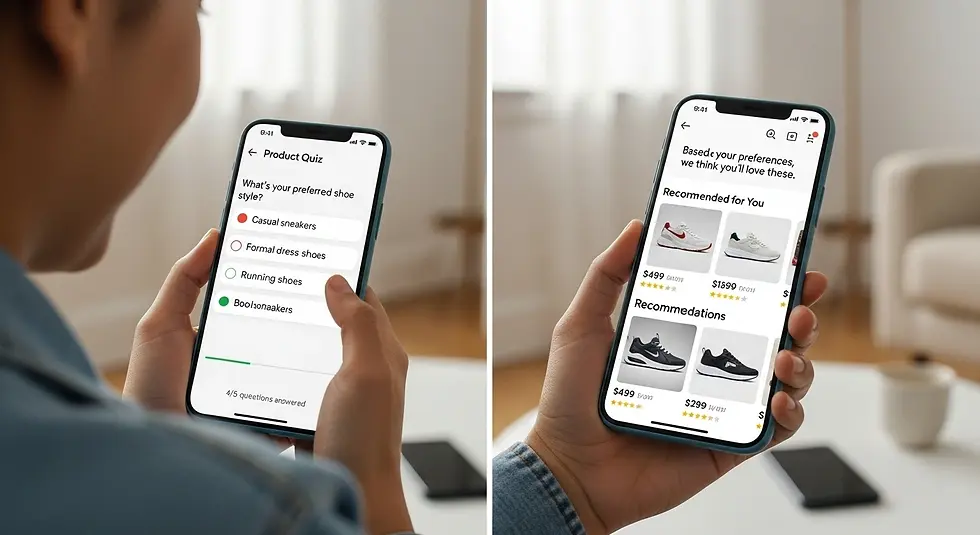
Zero-Party Data Changes the Game for AI Shopping
Zero-party data means information customers intentionally share: "I have oily skin," "I'm shopping for my daughter's first apartment," "I prefer synthetic fabrics for workouts." This differs completely from tracking what people click or browse.
Research shows that explicit preferences give algorithms high-confidence signals. Someone browsing ten categories might just be exploring. Someone completing a quiz stating their specific needs is actively seeking solutions.
This matters enormously for Google AI shopping. The algorithms work best with clear signals about what people want, not probabilistic guesses from browsing patterns.
Product Quizzes Generate Exactly What Google Needs
Quizzes create explicit connections between customer needs and product features. When someone answers "What's your primary skin concern?" and selects "dark spots," they've provided a semantic signal that goes straight to intent.
The quiz logic then maps that response to products with brightening ingredients or vitamin C. Each pathway represents a different customer segment, and the products at the end have documented connections to those specific needs.
This structured relationship—customer attribute to product feature to outcome—gives Google's algorithms confidence. Creating this manually would require tagging every product with every possible use case. Quizzes automate the process by capturing customers' own descriptions of their needs.
Quiz Result Pages Become Search Landing Pages
Each quiz outcome can have its own URL. Instead of a generic "/quiz-results" page, create URLs like "/quiz-results/oily-skin-anti-aging-vitamin-c" that Google can crawl and rank for specific queries.
These pages work for two audiences:
Quiz takers who answered questions and got personalized recommendations
Search visitors who land directly because Google thinks this result answers their query
Proper schema markup on these pages helps Google AI shopping assistant understand the context. Product schema for recommended items, FAQ Page schema for common questions, and Review schema for testimonials all add semantic richness.
Content Clusters Mirror Quiz Logic
Each quiz path represents a shopping journey that likely mirrors actual searches. Someone taking a skincare quiz answers questions about skin type, concerns, age range, and preferences. The result page addresses a specific need: "anti-aging routine for sensitive dry skin without retinol."
Supporting content around these segments creates connections. Blog posts about choosing moisturizer for combination skin can link to relevant quiz pathways. This signals to Google that these pieces serve similar user intents.
Shopify Stores Need Strategic Quiz Apps
Shopify's native features lack tools for capturing customer preferences in structured ways. Product variants organize inventory but don't capture the "why" behind purchases.
Visual Quiz Builder Optimizes for Search Automatically
Visual Quiz Builder generates SEO-friendly structures without requiring technical expertise.
SKOON's skin assessment quiz demonstrates this approach. The quiz adapts to skin type, concerns, lifestyle, and ingredient preferences. Each result pathway corresponds to a specific search intent.

Someone searching "natural skincare routine for sensitive acne-prone skin" might land on a result page generated by quiz logic, even without taking the quiz. The structured data helps Google's algorithms understand relationships between ingredients, concerns, and efficacy.
Cellcosmet's regimen finder focuses on complete routines rather than single products. This matches how people actually search: "complete skincare routine for mature skin" or "luxury anti-aging regimen."

Technical Features That Influence Rankings
Mobile-first design matters because Google predominantly uses mobile versions for indexing. Quizzes that work poorly on phones hurt visibility regardless of desktop performance.
Page speed affects both user satisfaction and search rankings. Fast, responsive quizzes signal quality to Google AI shopping systems. Analytics integration reveals which quiz segments convert best and how quiz traffic performs compared to other sources.
Getting Started With Quiz Optimization
Product quizzes offer the most efficient path to generating structured data at scale. Rather than manually tagging every product, quizzes capture customers' descriptions of their needs and document which products satisfy those requirements.
Strategic implementation enhances immediate user experience and long-term search visibility. Customers get personalized recommendations that feel genuinely helpful. Every quiz interaction generates data that feeds into better content and richer product descriptions.
Tools like Visual Quiz Builder handle technical implementation without requiring development resources. The platform manages structured data, creates SEO-friendly architectures, and integrates with Shopify stores seamlessly.
Frequently Asked Questions
How does Google's AI Shopping differ from traditional Google Shopping ads?
Traditional ads rely on keyword matching and bid amounts. Google AI shopping uses language models to interpret intent and understand context. AI-driven Google shopping ads consider user preferences, seasonal relevance, and problem-solution relationships that traditional ads can't process. Results often appear in AI Overviews rather than standard ad slots.
Can product quizzes really help my products appear in Google AI Overviews?
Yes, though indirectly. Quizzes create structured, intent-based content that these systems prioritize. Result pages with proper schema markup and clear connections between needs and recommendations become strong candidates for ranking. Quiz data also helps create comprehensive content—blog posts, descriptions, comparisons—that reinforces the same semantic relationships Google AI shopping needs.
Do I need technical knowledge to implement structured data from product quizzes?
Not if using platforms designed with this functionality built in. Visual Quiz Builder automatically generates schema markup and SEO-friendly structures. Understanding basic concepts helps with strategy, but most tools handle technical implementation.
How long does it take to see results from quiz-optimized content in Google AI Shopping?
New result pages might get indexed within days, but building ranking momentum typically takes several weeks to months. Quiz-generated content often targets specific, long-tail intents with lower competition. A page for "moisturizer for sensitive combination skin in dry climate" faces less competition than generic "moisturizer" pages, potentially ranking faster. Think of quiz implementation as part of a three-to-six-month optimization cycle rather than a quick fix.


